Decarbonizer Logic
Methodology on how the Decarbonizer works so you can make your own
This blog is a step-by-step explainer on the methodology of the Decarbonizer. In effect, it is a how-to-guide to help you build your own Decarbonizer. The Decarbonizer consists of only five building blocks. Input, Power Profiles and Output are the core if the tool, Reporting and Database make interpretation and programming easy. Each block contains several modules. Input and Output only contain parameters. Power Profiles performs calculations. Reporting is nothing more than a GUI containing specific parameters from other blocks. Database contains submodules with both parameters and calculations.
If you need more help, you can ask for support for implementation, or you can purchase the full backend in order to make your own version of the Decarbonizer even faster. Request assistance via this form and we’ll get back to you asap.
-
Decarbonizer needs maintenance
The Decarbonizer is much like a vessel. She is constantly evolving, she needs repairs, upgrades, sometimes a big overhaul – though she never needs to be drydocked. That means that although the logic should be agnostic and somewhat timeless, small difference might exists between this document and your version of the Decarbonizer.
One should not underestimate the amount of maintenance work and time involved in keeping your own version of the Decarbonizer online. It goes without saying that Sustainable Ships can provide you with help on both implementation and support during operation, but that is not the goal of this document.
We are human
It should be noted that Sustainable Ships works with a set of best practices and principles, but small errors and conflicts still arise in the tool. That’s right, we are only human. We rely on your hones feedback to improve the tool according to your expectations.
It is but a model
Sustainable Ships is not (really) interested in the exact answer. This might sound weird, so let us explain. We want to make insights as quickly as possible and as accurate as can be, so you get information that can steer your decision making. We are aware the Decarbonizer is and will remain but a model, which does not have the capacity as a virtual twin. And even the very best and most beautiful models in the world remain simply that – models. They are not a reflection of reality and one most always remain critical and keep their common sense when interpreting the output provided.
References and validation
The below stories are examples of vessels and technologies, which have been incorporated into the Decarbonizer tool. This includes technical lessons, as well as cost predictions.
This is a case study on the ‘Skoon Skipper’, a general cargo large Rhine vessel, with an average of 40 [kW] power demand while moored to which a shore battery is applied. Batteries can help you comply with shore power regulations where no infrastructure exists with limited to no CAPEX investments. CAPEX is €0 for this case study as the battery pack is rented at an estimated €400 dayrate. Purchase cost for battery pack are approx. €350.000. This case study is powered by our preferred partner Skoon.
This is a case study on how to decarbonize a fishing trawler - the Jacobus Maria - using shore power, battery hybrid EES and biofuels. 20% CO2 reduction is achieved, half of which stems from the use of biofuels (HVO). The hybrid battery pack is economically not feasible with the assumptions used and the operational profile. The Jacobus Maria has 1 MW installed engine capacity. Total cost would be at least €1M. 10% CO2 reduction can be achieved with approx. €50k.
This is a case study on how to decarbonize a ro-ro passenger vessel by applying Ecospeed to its hull. Ecospeed is a hard, non-toxic coating which provides long-lasting protection for all ship hulls. The hypothetic vessel is called ‘Lady Ice Cold’, a ro-ro operating in North-Western Europe with 33 MW installed engine capacity. Ecospeed reduces carbon emissions by 9% - 16% with a total CAPEX of €390.000.
This is a case study on how to decarbonize a tug by making it full electric. It is an homage to Damen’s electric tug ‘Sparky’. In practice, fully electrifying a vessel means to install a - very large - battery pack, in this case at least 3 MWh. This would also be the largest cost component, outweighing switchboard modifications, inverter and other electrical equipment. Cost reductions in OPEX/dayrate are high, between 50% to 90% in extreme cases.
Damen’s first all-electric harbour tug, the RSD-E Tug 2513, is a high-powered tug with 70-tonnes bollard pull, capable of manoeuvring even the largest vessels. It can undertake two or more assignments before being recharged, which takes just two hours. The battery pack size is 2,800 kWh, resulting an approximately 1,400 kW of charging power required. The battery pack is design for the vessel’s 30 year lifetime.
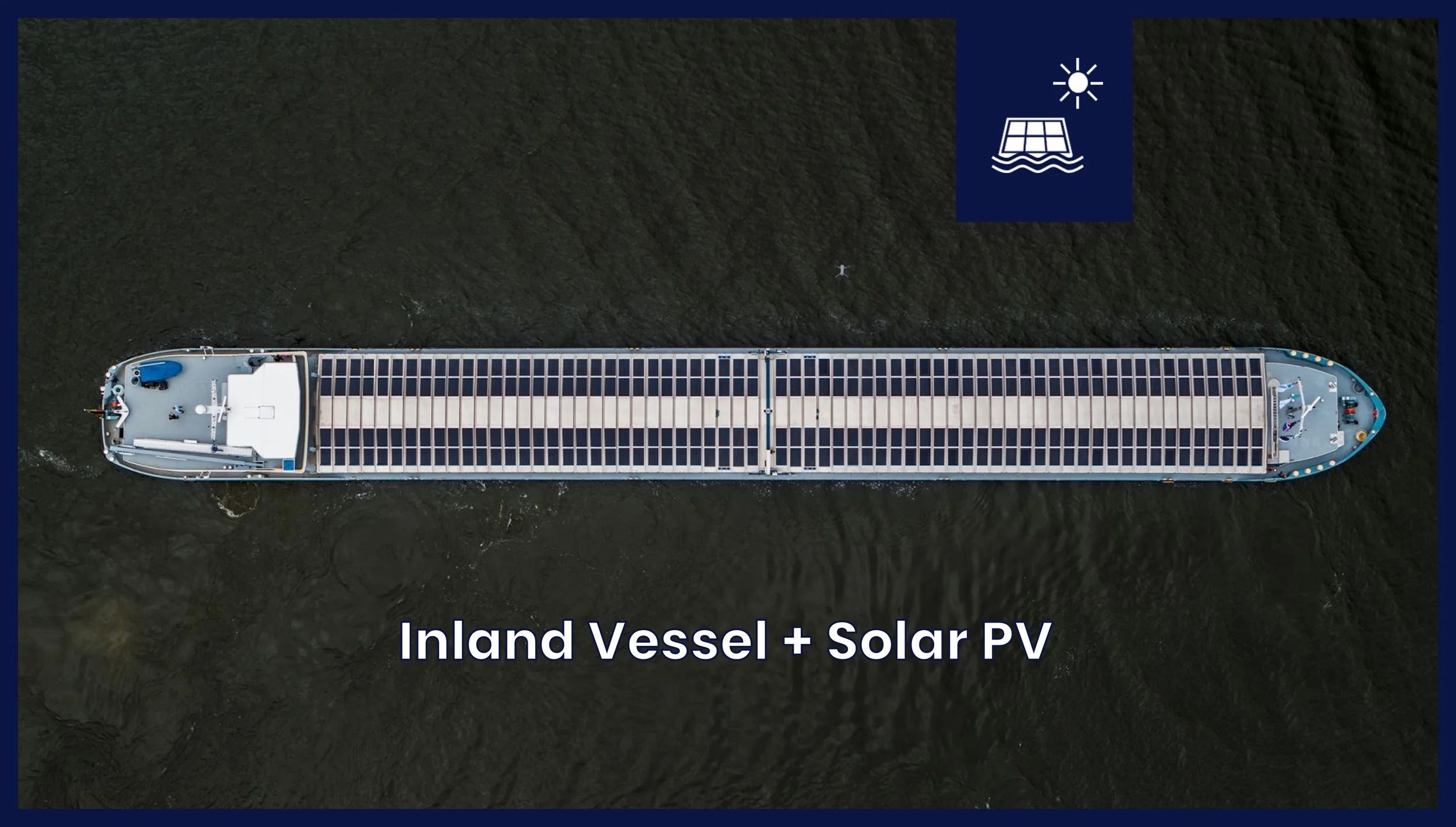
This is a case study on how to decarbonize an inland waterway ship with solar PV technology. Flexible solar PV panels from Wattlab are placed on an inland ship’s hatches in order to reduce fuel consumption while idling or moored. In some cases, the auxiliary generators can be switched off, resulting in an expected CO2 reduction of 26% - 100%.
This blog is a state of the use of methanol as marine fuel as “quick” reference for shipowners. Key points include costs for retrofitting the ship and engine, range between € 250-€650 per kW, elaboration on IGF code for low flashpoint fuels and technical considerations for conversion and working with methanol. Availability for methanol is good, but bunkering for large vessels mostly non-existent. Methanol price per kilogram is historically lower than regular MGO.
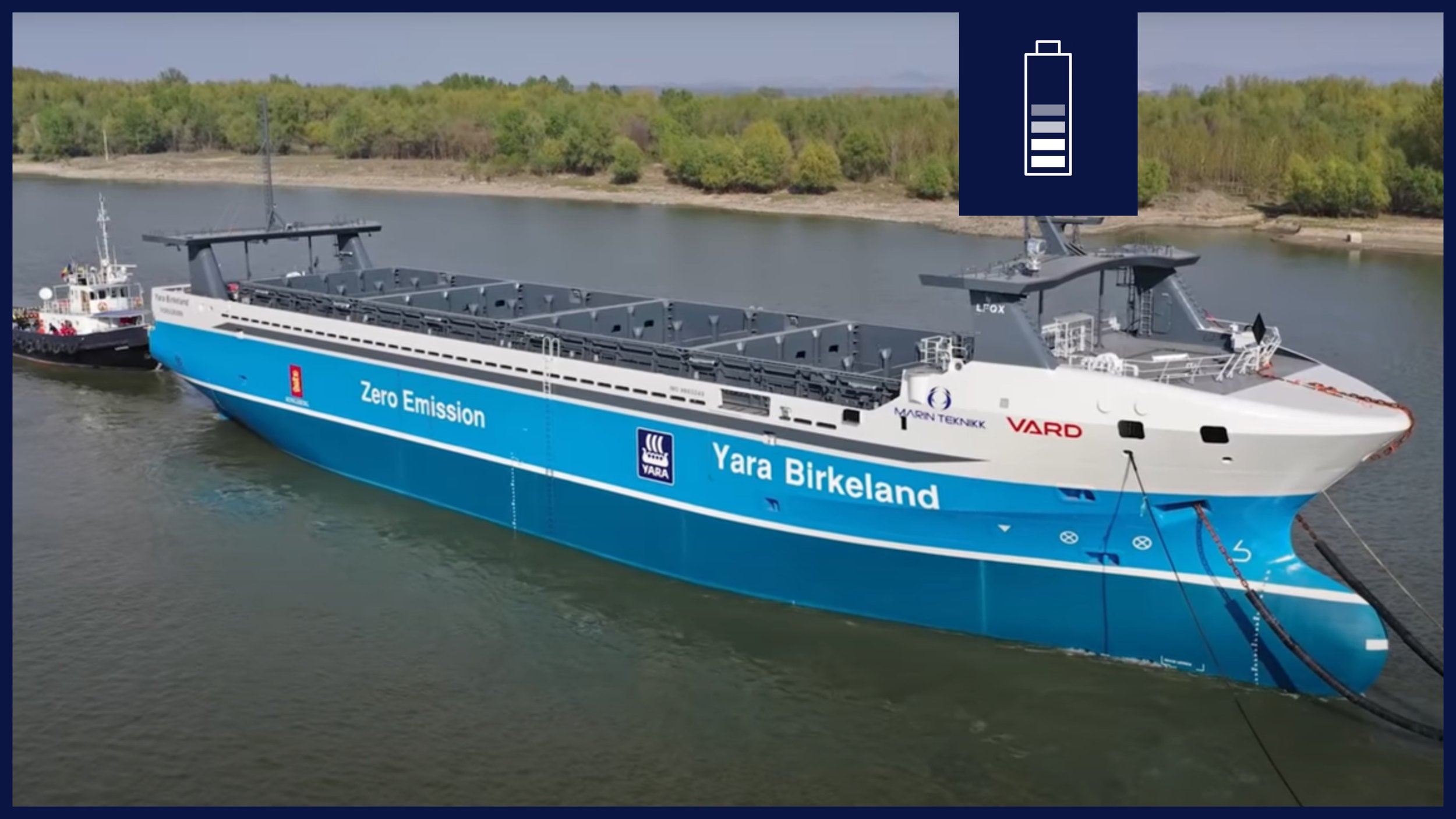
Dubbed ‘the Tesla of the seas’ this fully-electrified, fully-autonomous cargo ship is already making waves. The Yara Birkeland has a 7MWh battery, charged by Norwegian hydro power. She can carry a little over 100 containers. The ship cost about 25 million dollars, about three times a “conventional ship price”, but will nonetheless cut OPEX for Yara by 90%.
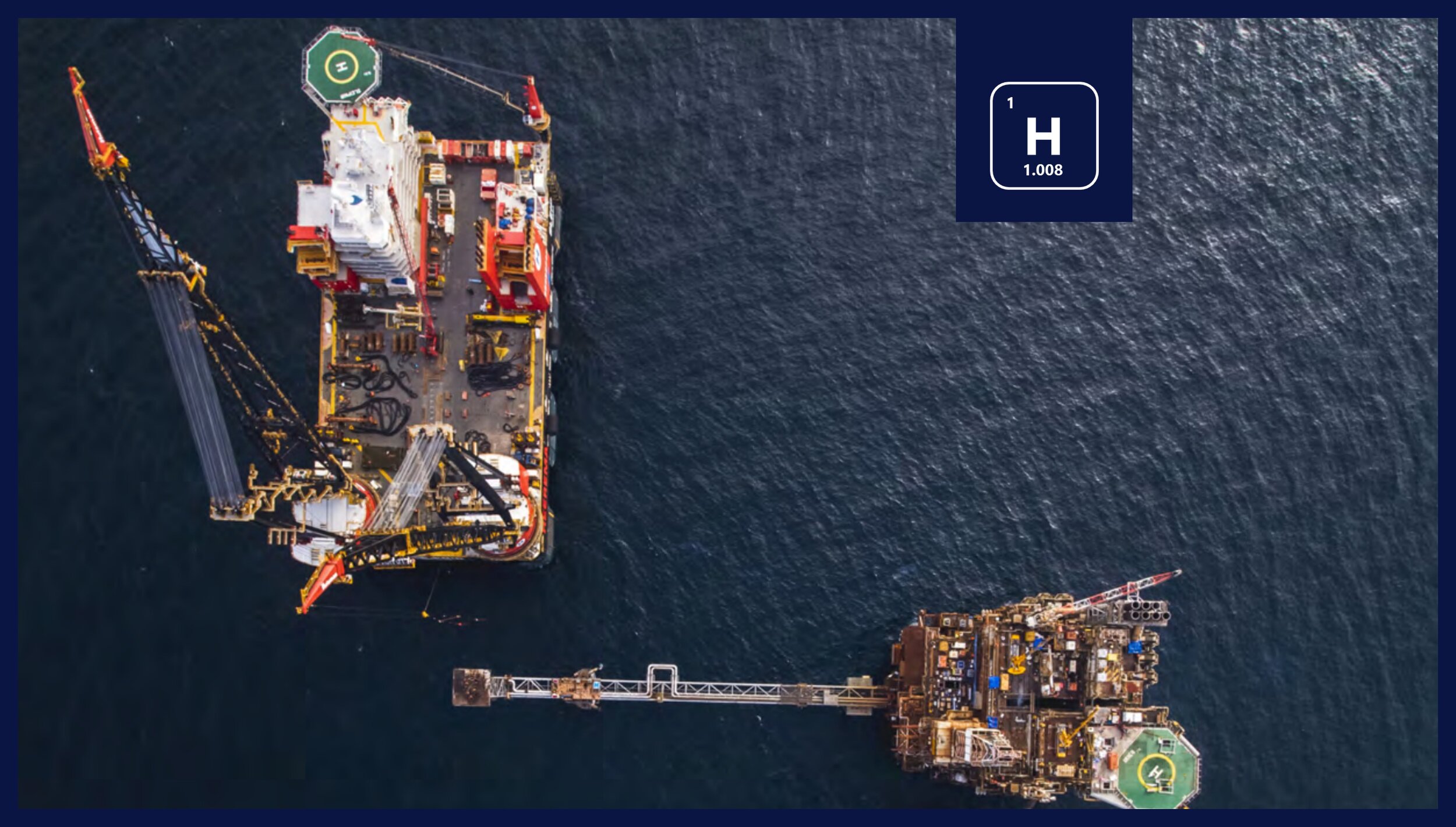
This thesis performs a technical, economical and environmental feasibility study of three dense hydrogen carriers as a fuel to power the largest semi-submersible offshore crane vessel in the world – Heerema’s Sleipnir.
The Alfa Lift, a new build heavy lift crane vessel owned by Offshore Heavy Transport, is on track to enter service by early 2022. The vessel features a 3,000 ton main crane, 10,000+ m² smart deck which can be fully submerged to a depth of 15 meters and a electric-hybrid battery system made by Kongsberg.
This thesis by J.M. Rozendaal at van Oord focuses on the technical, environmental and economic impact of a methanol hybrid power plant design for new-build offshore working vessels. Its conclusion is that a methanol solution has a CO2 reduction potential up to 99% and a CO2 price of 78 euro per ton CO2 reduction.
The North Sea Giant, a Norwegian offshore construction vessel, is the first DNV class-approved ‘hybrid’ DP3 vessel with three batteries on-board that have a total capacity of 2.034 kWh. The batteries have been installed in an upgrade and serve the purpose of spinning reserve, peak shaving and load leveling. Since then, fuel consumption is reduced in all operational modes with over 2 million liters of diesel per year, saving up to 30% fuel.
This is a story about how the shore power connection for Heerema in the Port of Rotterdam was realized from idea to reality. It is told from the perspective of Heerema, but could not be realized without help from Eneco, Siemens, Port of Rotterdam, the City Council of Rotterdam and InnovationQuarter. This story portrays the power of open collaboration for a sustainable future, and shows what can be achieved when working together on a common cause.
Designed in 2017 and launched in 2018, Hurtigreten has launched two new hybrid cruise vessels, the MS Roald Amundsen and MS Fridjof Nansen, that can sail fully electric for up to 30 minutes. Not only will it significantly reduce emissions, a hybrid system is also extremely quit. Arctic exploration has never been so much fun!
This case study examines a general cargo ship with an auxiliary engine of 116 kW that is outfitted with a battery to make it a ‘battery hybrid’ while at berth. The battery pack powers the ship for several hours while idling or moored and is recharged using the auxiliary engines. Cost savings generally occur with an average engine load below 50%, but are mostly dependent on engine maintenance costs, spares and consumables as well as total battery pack costs.